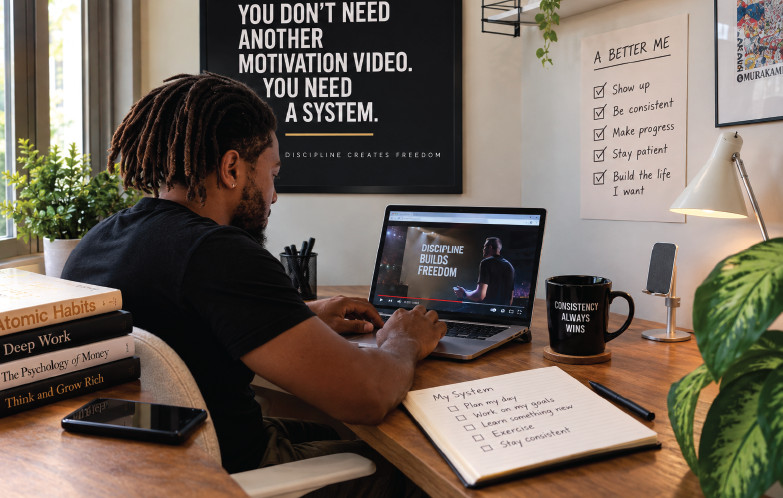
There is a strange comfort in watching a really good motivation video especially if it’s about self-improvement.
For ten minutes, everything feels possible.
You watch someone talking about discipline, success, money, fitness, business or personal growth. The music rises. The speaker says exactly what you needed to hear. Suddenly, your problems seem smaller.
You close the video feeling different, maybe tomorrow will be the day you wake up early. Maybe you’ll finally start that business.
Maybe you’ll learn the skill you’ve been postponing, maybe you’ll exercise every morning.
Maybe you’ll stop wasting time.
You feel ready.
Then tomorrow comes.
And somehow, the motivation is gone.
You wake up late. You check your phone. You tell yourself you’ll start after breakfast. Then after lunch. Then tomorrow.
Sound familiar?
The problem probably isn’t that you need more motivation.
You probably need a system.
Motivation Feels Powerful — Until It Doesn’t
Motivation is useful. There’s no need to pretend otherwise.
Sometimes a powerful speech, a personal story or a simple quote can push us to take the first step. Motivation can give us the emotional energy to begin.
But motivation has one major weakness:
It is temporary.
You don’t control how motivated you will feel every morning.
Some days you’ll wake up excited about your goals. Other days you’ll wake up tired, distracted, worried about money, frustrated by work or simply not in the mood.
If your progress depends entirely on feeling motivated, your progress will always be inconsistent.
This is why people can spend months consuming self-improvement content without actually improving their lives.
They aren’t necessarily lazy.
They aren’t necessarily incapable.
They may simply have confused inspiration with action.
Watching someone explain how to become successful isn’t the same as becoming successful.
Reading about discipline isn’t the same as being disciplined.
Saving a hundred productivity posts isn’t the same as becoming productive.
At some point, inspiration has to become a structure.
That’s where a system comes in.
What Is a Personal System?
A system is simply a repeatable way of doing something.
It removes some of the daily negotiation between what you want to do and whether you feel like doing it.
Think about brushing your teeth.
You don’t wake up every morning and ask:
“Am I motivated enough to brush my teeth today?”
You just do it.
Why?
Because it has become part of your routine.
You don’t need a motivational speech from your dentist every morning.
The same principle can be applied to bigger goals.
If you want to write a book, don’t simply say:
“I want to write a book.”
Create a system:
Write 500 words every weekday at 7:00 AM.
If you want to become fitter, don’t say:
“I need to exercise more.”
Create a system:
Exercise for 30 minutes every Monday, Wednesday and Friday.
If you want to develop a valuable skill, don’t say:
“I need to learn something new.”
Create a system:
Spend one hour learning and practicing the skill every evening.
The goal gives you direction.
The system gives you movement.
Goals Are Important, But They Aren’t Enough
We love talking about goals.
Lose 10 kilograms.
Make more money.
Start a business.
Get a better job.
Write a book.
Build a personal brand.
Become financially independent.
These are all legitimate ambitions.
But there’s a problem with focusing only on the destination.
A goal tells you where you want to go.
It doesn’t necessarily tell you what you should do today.
Imagine saying:
“I want to build a successful business.”
That’s a goal.
But what happens on Tuesday morning?
What exactly are you supposed to do?
A system turns the ambition into actions.
Research the market.
Speak to five potential customers.
Improve the product.
Publish useful content.
Track expenses.
Study competitors.
Follow up with leads.
Repeat.
Suddenly, the dream becomes something you can actually work on.
This is the difference between hoping for a different life and building one.
Stop Trying to Change Your Entire Life Overnight
Another reason motivation disappears is that we often ask too much of ourselves.
We watch a video about someone’s incredible transformation and decide we’re going to change everything at once.
Tomorrow we’ll wake up at 5 AM.
Exercise.
Meditate.
Read for an hour.
Work on the business.
Learn coding.
Eat perfectly.
Stop social media.
Journal.
Sleep by 9 PM.
And, somehow, become a completely different human being by Friday.
It sounds impressive.
It is also a fantastic way to burn yourself out.
Real personal growth is usually less dramatic.
It’s often boring.
It’s waking up and doing the thing again.
And again.
And again.
It’s reading ten pages instead of promising yourself you’ll read five books this month.
It’s saving a small amount of money instead of waiting until you earn more.
It’s practicing a skill for thirty minutes instead of spending three hours watching videos about it.
It’s publishing one piece of work instead of endlessly preparing to become “ready.”
Small actions become powerful when they are repeated.
Build Systems That Work on Bad Days
This might be one of the most important principles of personal growth:
Don’t build a system for your best days. Build one that can survive your worst days.
Your perfect routine might look impressive on paper.
Two hours at the gym.
Three hours of focused work.
One hour of reading.
One hour of learning.
Perfect diet.
No distractions.
But what happens when you’re exhausted?
What happens when your business has a bad week?
What happens when something goes wrong at home?
What happens when you simply don’t feel like doing anything?
A good system has a minimum version.
If you normally write for one hour, perhaps your minimum is 15 minutes.
If you normally exercise for 45 minutes, perhaps your minimum is 10 minutes.
If you normally study for an hour, perhaps your minimum is 20 minutes.
The point isn’t to make excuses.
The point is to protect consistency.
You don’t have to win every day.
You just don’t want one bad day to become a bad month.
Make Progress Easier to See
One reason people give up is that progress can be invisible.
You exercise for a week and don’t see a dramatic physical change.
You start a business and don’t immediately make money.
You practice a skill and still feel like a beginner.
You create content and nobody seems to notice.
You save money and the amount still looks small.
It can be frustrating.
That’s why tracking matters.
Keep a simple record of what you’re doing.
A notebook is enough.
A calendar is enough.
A spreadsheet is enough.
Write down:
- What you did
- How often you did it
- What improved
- What didn’t work
- What you need to change
After a few weeks, something interesting happens.
You can see evidence that you’re moving.
And evidence is often more powerful than motivation.
Instead of telling yourself, “I think I’m getting better,” you can look at your record and say:
“I actually am.”
Your Environment Is Part of Your System
Sometimes we blame ourselves for having no discipline when the real problem is our environment.
If your phone is beside you while you’re trying to work, distraction is always one tap away.
If junk food is sitting on your desk, you’re making the decision repeatedly.
If your workspace is chaotic, starting becomes harder.
If everyone around you spends their evenings complaining about life, your ambitions can begin to feel unrealistic.
Your environment quietly influences your behavior.
So make the desired behavior easier.
Put your phone away when you’re working.
Prepare your workout clothes the night before.
Keep your book somewhere visible.
Create a dedicated workspace.
Follow people who challenge your thinking.
Spend time with people who are building something.
You don’t need extraordinary willpower when your environment supports the person you’re trying to become.
Stop Waiting to Feel Ready
One of the biggest traps in personal development is waiting for the perfect moment.
“I’ll start when I have more money.”
“I’ll start when I understand everything.”
“I’ll start when I’m more confident.”
“I’ll start when life becomes less busy.”
“I’ll start when I feel motivated.”
The problem is that the perfect moment rarely arrives.
Confidence often comes after action, not before it.
You become better by practicing.
You become disciplined by doing things when you don’t feel like doing them.
You become confident by surviving situations that once intimidated you.
You learn by starting before you know everything.
There is nothing wrong with preparing.
But preparation can quietly become procrastination when it never turns into action.
At some point, you have to begin.
You Don’t Need to Become a Different Person
Self-improvement is sometimes presented as if your current self is a problem that needs to be destroyed.
It isn’t.
You don’t have to wake up tomorrow and become an entirely different person.
You simply need to become slightly better at keeping promises to yourself.
If you say you’ll read ten pages, read ten pages.
If you say you’ll exercise, exercise.
If you say you’ll spend an hour learning, spend the hour.
Every time you follow through, you send yourself a message:
“I can trust myself.”
That might be one of the most valuable things personal growth can give you.
Not endless motivation.
Not the appearance of being productive.
Self-trust.
The Real Secret Is Consistency
There will always be another motivational video.
Another book.
Another podcast.
Another productivity hack.
Another morning routine.
Another successful person explaining their five secrets.
And some of them will genuinely help you.
But eventually, you have to close the video.
Put down the book.
Turn off the podcast.
And do the work.
Because your life doesn’t change because you discovered another great idea.
It changes when a good idea becomes a repeated behavior.
You don’t need to feel motivated every day.
You need a structure that reminds you what matters when motivation disappears.
You need habits that make progress normal.
You need systems that turn intentions into actions.
And you need enough patience to let those actions compound.
Build the System. Then Keep Showing Up.
Maybe you’ve been waiting for motivation to arrive.
Maybe you’ve been watching videos, saving quotes and making plans because planning feels safer than starting.
Maybe you’ve been telling yourself that you’ll begin when you’re ready.
Here’s a different approach.
Pick one thing.
Not ten.
One.
Decide what progress looks like.
Create a small daily or weekly action.
Choose when and where you’ll do it.
Remove one distraction.
Track your progress.
Then repeat.
Don’t worry about becoming extraordinary overnight.
Just become someone who keeps showing up.
Because eventually, those ordinary days begin to add up.
The person who reads ten pages every day eventually finishes books.
The person who practices every week eventually develops a skill.
The person who saves consistently eventually builds financial breathing room.
The person who publishes consistently eventually builds a body of work.
The person who keeps showing up eventually looks back and realizes something important:
They didn’t suddenly become successful.
They built a system.
They followed it.
And over time, the system changed them.
So before you watch another motivation video today, ask yourself one simple question:
What am I going to do differently after this video ends?
If the answer is nothing, you probably don’t need another video.
You need a system.
More Articles: Media Wall