Why Customers Are No Longer Looking for Your Business but watching it.
There was a time when marketing a business was relatively simple.
You opened a shop. Put up a sign. Printed some flyers. Told people what you sold. Maybe bought an advert on radio. If someone needed what you offered, they asked around, walked into town, or called a number they had saved.
That world hasn’t disappeared.
But the way customers discover businesses has changed dramatically.
Today, a potential customer might discover your restaurant while watching TikTok. They might see your hotel on Instagram, check its reviews on Google, look at photos posted by previous customers, send a WhatsApp message, compare three competitors and only then decide whether to buy.
In other words, the customer may never have been looking for your business specifically.
They were looking for a solution.
And that’s an important distinction.
Your Customer May Be Searching for an Answer, Not Your Business
Imagine someone in Kampala needs a birthday cake.
They may not know your bakery exists.
So they don’t search:
“ABC Bakery Kampala.”
They might search:
“Best birthday cakes in Kampala.”
Or:
“Affordable birthday cake near me.”
Or they may open TikTok and search for cake ideas,
Or ask friends in a WhatsApp group.
Or see a cake video somebody shared.
Or ask an AI tool for recommendations.
The business that understands this doesn’t spend all its energy shouting:
“We sell cakes!”
It creates content and information that answers the customer’s question.
That’s the fundamental shift.
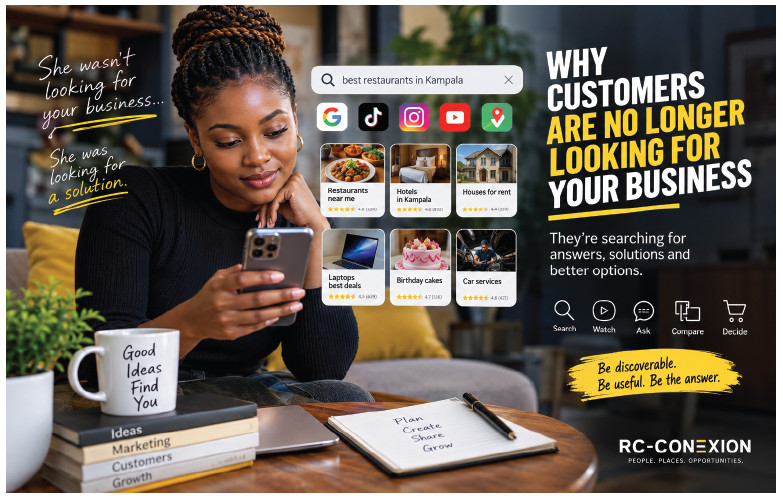
Customers are increasingly discovering businesses through problems, interests, recommendations and content—not just business names.
Research into local search behavior published in 2026 found that 84% of consumers had searched for a local business online within the previous three months, while three-quarters used more than one channel during their most recent local-business search. Google remained the leading channel, but consumers did not necessarily stop at Google.
That has enormous implications for small businesses.
Uganda’s Customer Journey Is Becoming More Digital
The shift is particularly relevant in Uganda.
According to the Uganda Communications Commission’s Q2 2026 market figures, TikTok had 11.4 million subscriptions in Uganda by June 2026, narrowly ahead of WhatsApp at 11 million. YouTube had 6.9 million, while Instagram had 1.5 million.
Those numbers don’t mean that every person with a subscription is a customer actively shopping on that platform. They do, however, show the enormous scale of the digital environments where Ugandans are spending time.
And there is another important finding.
The 2026 National Audience Measurement Survey, conducted across 146 districts with 22,059 respondents, found that Ugandans increasingly consume media across multiple platforms. It estimated 7.3 million weekly social-media users and 7.6 million users of instant-messaging applications, with particularly strong digital engagement among people aged 18–29.
So your customer isn’t necessarily sitting in front of a computer thinking:
“Let me search for a company that sells this.”
They may be watching, chatting, scrolling, comparing and discovering.
Your business needs to exist within that journey.
The Biggest Marketing Mistake: Only Posting Your Products
Open the social-media page of many businesses and you’ll find the same pattern.
Monday: Product photo.
Tuesday: Product photo.
Wednesday: “We are open.”
Thursday: Product photo.
Friday: “Weekend offer!”
There is nothing inherently wrong with showing what you sell.
The problem is that your customer doesn’t wake up every morning wanting to look at advertisements.
They have questions.
They have problems.
They want ideas.
They want comparisons.
They want reassurance.
They want to know whether you’re trustworthy.
They want to know what something looks like in real life.
They want to know whether the price is reasonable.
They want to know whether other people have had a good experience.
Your content should answer those questions.
For example, a furniture business could simply post:
“3-Seater Sofa — UGX X.”
Or it could create:
“5 things to check before buying a sofa in Kampala.”
The second piece has a completely different job.
It attracts someone before they have chosen a seller.
That is where modern content marketing becomes powerful.
Don’t Sell the Product. Solve the Problem.
Let’s take a real-world example.
Suppose you sell laptops.
Your traditional post might say:
HP EliteBook
8GB RAM
256GB SSD
UGX 1,200,000
Useful? Yes.
But you’re competing with dozens of other sellers posting almost identical information.
Instead, create:
“Don’t Buy a Laptop Until You Check These 5 Things.”
Then explain:
- What processor does it have?
- How much RAM do you actually need?
- Is the storage SSD or HDD?
- What condition is the battery in?
- Does it come with a genuine warranty?
Now you’ve changed your position.
You’re no longer simply selling laptops.
You’re helping people make a laptop-buying decision.
And when that person eventually needs a laptop, who are they more likely to remember?
The seller who repeatedly posted prices?
Or the business that taught them how to avoid buying the wrong machine?
Social Media Is Becoming Part of Search
This is one of the biggest changes businesses need to understand.
Search isn’t necessarily one box on Google anymore.
People increasingly search within platforms.
They search TikTok for restaurants.
Instagram for fashion.
YouTube for tutorials.
Facebook for local recommendations.
WhatsApp for referrals.
And Google for information, businesses, locations and comparisons.
This doesn’t mean Google is becoming irrelevant. Quite the opposite.
Google says its AI-powered search experiences still rely on its core Search systems and indexed web content, and it continues to recommend the fundamentals of good SEO: useful, reliable, people-first content.
The lesson isn’t:
“Forget your website and move to TikTok.”
It’s:
Stop treating every platform as if customers use it in exactly the same way.
Your website can answer detailed questions.
Your TikTok can demonstrate.
Your Instagram can inspire.
Your Facebook can build community.
Your WhatsApp can handle conversations.
Your Google Business Profile can help people find you locally.
These aren’t necessarily competing channels.
They can become different parts of the same customer journey.
Your Business Needs to Be Discover-able Before It Is Needed
This is where many small businesses lose opportunities.
They start marketing aggressively only when sales become slow.
But by then, they’re asking strangers to trust them immediately.
Imagine instead that someone has been seeing your content for six months.
You’ve shown them how to choose the right product.
You’ve answered common questions.
You’ve demonstrated your work.
You’ve shared customer experiences.
You’ve explained your prices.
You’ve shown your location.
You’ve responded to comments.
You’ve solved problems.
When they finally need your service, you’re no longer a stranger.
You’ve already been introduced.
That is the real value of consistent content.
Trust Has Become Part of the Product
A customer isn’t only asking:
“How much does it cost?”
They’re also asking:
“Can I trust these people?”
That question becomes especially important when purchasing online or from a business someone has never used before.
Research published in 2026 on social-media marketing and purchase intention among digitally active fast-food customers in Kampala found that customization, interaction and trendiness influenced customer engagement, while engagement was associated with purchase intention.
That tells us something important.
People aren’t necessarily persuaded simply because you posted an advert.
The relationship around the advert matters.
How you respond.
How relevant your content is.
Whether you understand the customer.
Whether you demonstrate your expertise.
Whether other people interact with your business.
Whether the experience feels genuine.
So What Should Your Business Post?
Instead of asking:
“What should we advertise today?”
Ask:
“What question is our customer asking today?”
If you’re a restaurant:
“What should I order for five people?”
If you’re a real-estate agent:
“What should I check before paying for land?”
If you’re a computer dealer:
“How much RAM do I actually need?”
If you’re a hotel:
“What should I look for when booking accommodation for a weekend?”
If you’re a fashion business:
“What should I wear to an introduction ceremony?”
If you’re a mechanic:
“Why does my car overheat when I’m stuck in traffic?”
These questions are content opportunities.
And more importantly, they’re search opportunities.
Someone who asks the question may not know your business yet.
That’s okay.
They don’t have to know your name before they discover your value.
More Articles: Media Wall
Similar Articles: BrightLocal